Table of Contents
Is your website starting to feel outdated? You're not alone. Studies show that 94% of first impressions are design-related, and users form opinions about your website in just 0.05 seconds. A strategic website redesign can dramatically improve your conversion rates, user engagement, and search engine rankings.
In this comprehensive guide, we'll walk you through everything you need to know about redesigning your website in 2025—from recognizing the warning signs that it's time for a refresh to implementing modern design principles that convert visitors into customers.
What is a Website Redesign?
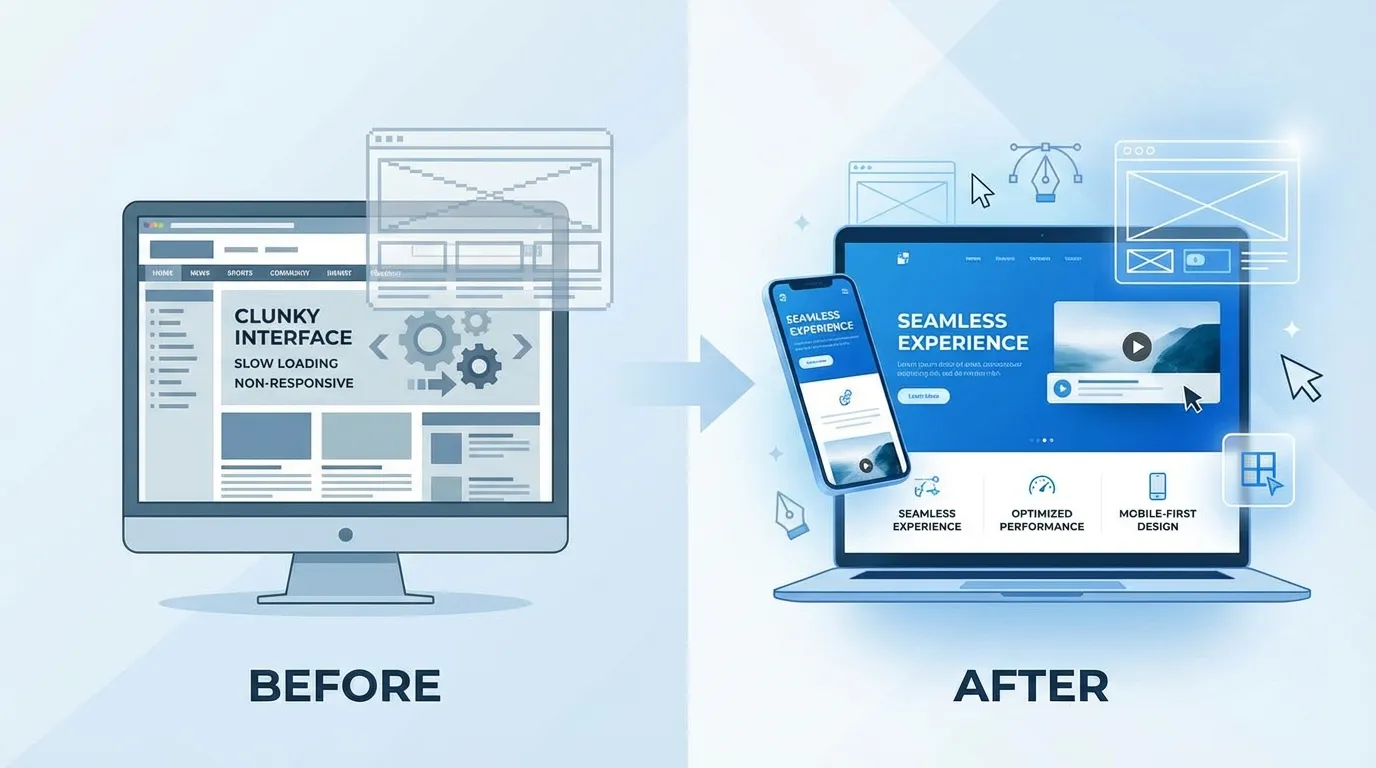
A website redesign involves making significant changes to your site's code, content, structure, and visuals to improve performance and user experience. Unlike a simple refresh that might involve updating colors or images, a full redesign addresses fundamental aspects of how your website functions and serves your business goals.
A successful website redesign project typically includes:
- Visual overhaul - Modernizing the look and feel with current design trends
- UX improvements - Enhancing navigation, user flows, and accessibility
- Technical upgrades - Improving code quality, speed, and mobile responsiveness
- Content restructuring - Reorganizing information architecture for better findability
- SEO optimization - Implementing best practices for search engine visibility
7 Warning Signs Your Website Needs a Redesign
How do you know when it's time to invest in a redesign versus making incremental updates? Here are the telltale signs:
1. High Bounce Rates
If visitors are leaving your site within seconds of arriving, your design may be failing to engage them. Industry benchmarks suggest bounce rates above 70% indicate serious usability issues that a redesign can address.
2. Poor Mobile Experience
With over 60% of web traffic coming from mobile devices in 2025, a non-responsive website is essentially turning away the majority of your potential customers. Modern web development prioritizes mobile-first design approaches.
3. Slow Loading Times
Google's Core Web Vitals now directly impact your search rankings. If your site takes more than 3 seconds to load, you're losing 40% of visitors. Our website speed optimization services can help identify and fix performance bottlenecks.
4. Outdated Visual Design
Design trends evolve rapidly. If your website looks like it was built in 2015, visitors will question whether your business is still relevant and trustworthy. Modern users expect clean layouts, intuitive navigation, and contemporary aesthetics.
5. Low Conversion Rates
Your website should be your hardest-working salesperson. If you're getting traffic but not conversions, your user experience and call-to-action placement likely need professional attention from UI/UX design experts.
6. Difficult Content Management
If updating your website requires technical expertise or takes hours for simple changes, your CMS is holding you back. A redesign can implement a more user-friendly content management system.
7. Security Vulnerabilities
Older websites often run on outdated platforms with known security holes. If you've experienced a hack or your site shows security warnings, it's time for a complete rebuild with modern security standards.
The Website Redesign Process: A Step-by-Step Framework
A successful redesign follows a structured methodology. Here's the proven process we use at ScalingWeb:
Phase 1: Discovery & Research (Weeks 1-2)
Before touching any design tools, we dive deep into understanding your business:
- Stakeholder interviews - Understanding your goals, challenges, and vision
- Analytics audit - Analyzing current performance data and user behavior
- Competitor analysis - Identifying industry benchmarks and opportunities
- User research - Understanding your target audience's needs and pain points
- Technical assessment - Evaluating current infrastructure and integration requirements
Phase 2: Strategy & Planning (Weeks 2-3)
With research insights in hand, we develop the strategic foundation:
- Information architecture - Organizing content for optimal user journeys
- Sitemap development - Mapping out the complete page structure
- SEO strategy - Planning keyword targeting and technical SEO improvements
- Content strategy - Identifying content gaps and migration needs
- Technology selection - Choosing the right platform and tools for your needs
Phase 3: Design & Prototyping (Weeks 3-5)
This is where your new website starts taking visual shape:
- Wireframing - Creating structural blueprints for key pages
- Visual design - Developing the look and feel with your brand guidelines
- Interactive prototypes - Building clickable mockups for stakeholder review
- Design system creation - Establishing reusable components for consistency
- Responsive design - Ensuring flawless experiences across all devices
Phase 4: Development & Implementation (Weeks 5-8)
Our development team brings the designs to life:
- Frontend development - Building the user interface with modern technologies
- Backend integration - Connecting databases, APIs, and business logic
- CMS configuration - Setting up easy content management
- Performance optimization - Implementing speed and efficiency improvements
- Security hardening - Adding protection against common vulnerabilities
Phase 5: Testing & Quality Assurance (Week 8-9)
Rigorous testing ensures a flawless launch:
- Cross-browser testing - Verifying compatibility across all major browsers
- Device testing - Checking responsiveness on phones, tablets, and desktops
- Functionality testing - Ensuring all features work as expected
- Performance testing - Validating load times and Core Web Vitals
- Accessibility audit - Confirming WCAG compliance for all users
Phase 6: Launch & Optimization (Week 9-10)
A strategic launch minimizes disruption and maximizes success:
- Migration planning - Carefully moving content and preserving SEO equity
- 301 redirects - Mapping old URLs to new to maintain search rankings
- Go-live execution - Coordinated deployment with minimal downtime
- Post-launch monitoring - Watching for issues and quick fixes
- Performance tracking - Measuring improvements against baseline metrics
Website Redesign Costs in 2025: What to Expect
Investment in a website redesign varies significantly based on scope and complexity:
| Project Type | Typical Cost Range | Timeline | Best For |
|---|---|---|---|
| Small Business Site | $5,000 - $15,000 | 4-6 weeks | 5-15 pages, basic functionality |
| Professional Services | $15,000 - $40,000 | 8-12 weeks | 20-50 pages, custom features |
| E-Commerce Platform | $25,000 - $100,000+ | 12-20 weeks | Full store with integrations |
| Enterprise Solution | $50,000 - $250,000+ | 16-30 weeks | Complex requirements, multiple integrations |
Factors that influence cost include custom functionality requirements, content migration complexity, third-party integrations, and ongoing website maintenance needs.
Modern Website Design Trends for 2025
Stay ahead of the curve by incorporating these current design trends:
1. AI-Powered Personalization
Websites are increasingly using AI and machine learning to deliver personalized experiences based on user behavior and preferences.
2. Micro-Interactions & Animation
Subtle animations guide users and provide feedback, making interfaces feel more responsive and engaging without overwhelming visitors.
3. Dark Mode Support
Offering dark mode options improves accessibility and reduces eye strain, while also giving your site a modern, sophisticated feel.
4. Voice Search Optimization
With voice assistants becoming ubiquitous, modern websites need content structured for voice search queries and featured snippets.
5. Sustainable Web Design
Eco-conscious design minimizes energy consumption through optimized images, efficient code, and green hosting solutions.
Common Website Redesign Mistakes to Avoid
Learn from others' missteps:
- Ignoring SEO during migration - Always plan 301 redirects and preserve existing rankings
- Skipping user research - Don't assume you know what users want without data
- Overcomplicating navigation - Keep menus simple and intuitive
- Neglecting mobile users - Design mobile-first, not as an afterthought
- Launching without testing - Always conduct thorough QA before going live
- Forgetting about content - Great design with poor content still fails
Measuring Redesign Success: Key Metrics to Track
After launch, monitor these KPIs to measure your redesign's impact:
- Bounce rate - Should decrease by 10-30%
- Average session duration - Should increase by 20-50%
- Conversion rate - Target 2-5x improvement
- Page load time - Aim for under 2 seconds
- Core Web Vitals - All metrics should be "Good"
- Organic traffic - Monitor for 3-6 months post-launch
Ready to Transform Your Website?
A website redesign is one of the most impactful investments you can make in your digital presence. Whether you're looking to improve conversions, modernize your brand, or outperform competitors, the right redesign strategy makes all the difference.
At ScalingWeb, we've helped over 150 businesses transform their online presence with strategic redesigns that deliver measurable results. Our team combines expert UI/UX design with robust web development to create websites that look stunning and perform brilliantly.
Ready to discuss your website redesign project? Contact us for a free consultation and discover how we can help elevate your online presence in 2025.

Written by
Stacy
Expert team in digital transformation and web technologies.